- HSBC sees a year of record profits in FY23, with a 78% jump in profit before tax year-on-year.
- Despite continuing to hold its portfolio in China, we expect mostly a minor impact on further credit losses coming from China.
- We remain optimistic about HSBC’s outlook, while its credit profile looks largely stable against past years.
- We like HSBC for the quality and market share it offers over other banks, particularly for USD senior unsecured bonds that provide good value.
Record profits in 2023
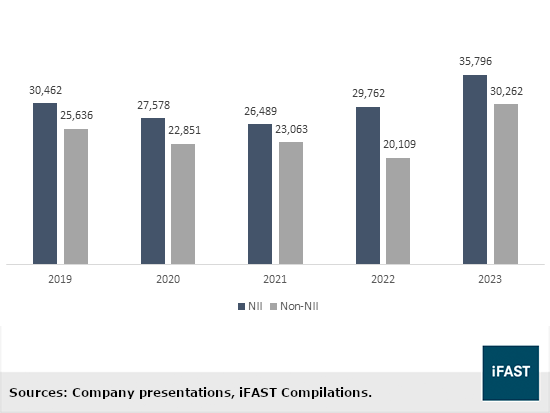
The year ended 31 December 2023 (“FY23”) was another great year for HSBC which enjoyed growth from various fronts. Revenue continued its rise in FY23, increasing by 32% year-on-year from USD 49.9b (FY22) to USD 66.1b (FY23), driven by both net interest income (“NII”) and non-NII, rising by 20% and 50% respectively YoY.
HSBC’s profit before tax (“PBT”) saw an astounding 78% jump from the previous year, from USD 17.1b in FY22 to USD 30.3b in FY23. This included several exceptional items for the year – (1) a favourable impact of USD 2.5b related to the sale of France retail operations, (2) USD 1.6b provisional gain on the acquisition of Silicon Valley Bank UK (“SVB UK”), offset by (3) USD 3.0b impairment due to valuation adjustments on its associate - Bank of Communications (“BoCom”) in China.
Well-managed costs further helped to support HSBC’s PBT growth in FY23. The bank’s costs fell by 2% YoY while the cost efficiency ratio improved from 64.6% in FY22 to 48.5% in FY23, despite the inflationary pressure across FY23. We expect HSBC’s ongoing effort in keeping costs low to greatly help with sustaining the current profit levels.
All three business segments of the Bank also reported strong performances for FY23. The Commercial Banking segment saw its PBT increase by 76% YoY, the Global Banking and Markets segment’s PBT saw an increase of 26% YoY, while the Wealth and Personal Banking segment’s PBT rose by an estimated 110% YoY. HSBC attributed the improved performance across its business operations to a growing international clientele base – an area of focus in the near future. The bank sees greater revenue coming from multi-jurisdictional clients as its connectivity across various regions would be a strong tool for such clients to tap into.
Chart 1
HSBC’s revenue and profit before tax over the
past years (in USD m)
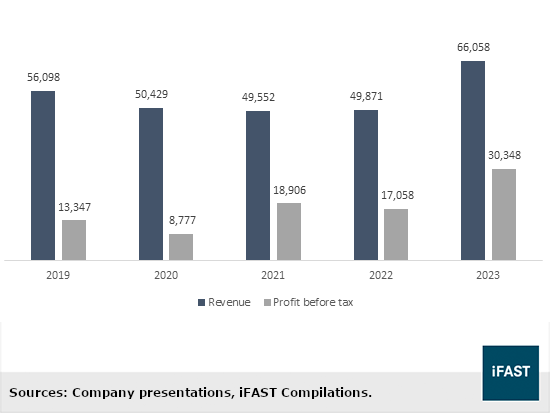
Chart 2
HSBC’s net increase income and non-NII over the
past years (in USD m)
Despite its China exposure, we see no need for concern
Across the major banks that we cover, HSBC is one of the few banks with significant holdings in China – predominantly in Hong Kong. For reference, HSBC’s business in Hong Kong contributed ~33% of its FY23 PBT while its business in mainland China (excluding the impact of the USD 3.0b impairment for BoCom) contributed ~10%. As part of its development plans, HSBC agreed to acquire Citi’s retail wealth management portfolio in mainland China in 4Q23 – comprising USD 3.6b in assets. While most foreign banks are trying to reduce their footprint in China, HSBC remains focused on its Asia business – with Hong Kong and mainland China holding a critical role in the region.
The BoCom impairment of USD 3.0b arosed as a result of an impairment test on the carrying value, as the recoverable amount as determined by a value-in-use calculation was lower than the carrying value. Despite the decrease in valuation, HSBC specified that the impairment will have no material impact on the Group’s capital, capital ratios or distribution capacity. Furthermore, the bank continues to see value in BoCom given the growth it has exprienced since the initial investment in 2004, especially with it being designated as a global systemically important bank (“G-SIB”) in November 2023.
We understand that investors might have concerns over HSBC’s business in mainland China, given the lacklustre economic growth that continues to plague the country (also the reason for the impairment of BoCom). However, we see efforts made by HSBC to mitigate the impact of China’s economic challenges, which should help to lessen investors’ worries about its operations in mainland China.
- Looking at its results across FY22 and FY23, performance contributed by its mainland China business appeared relatively resilient. Despite the weak economic growth and excluding the USD 3.0b BoCom impairment, PBT from mainland China’s business remained roughly constant at about USD 3.4b across both years.
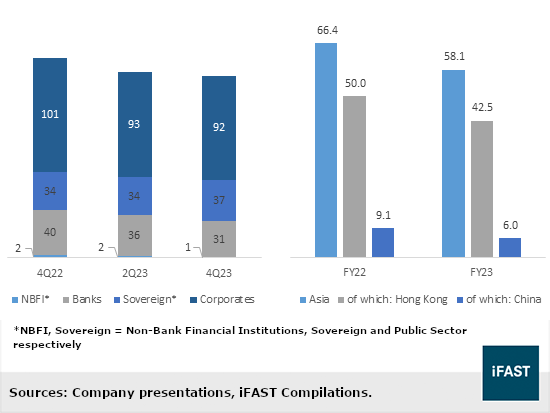
- In addition, we observed a gradual reduction in HSBC’s wholesale lending in mainland China (the majority of its loan portfolio aside from mortgages and credit cards). Across the year, wholesale lending has been declining – which we believe is likely due to more careful disbursement of new loans. HSBC remarked that 55% of the corporate lending is provided to foreign-owned enterprises and state-owned enterprises, with only 45% to private sector-owned enterprises qs of December 2023.
- The situation is similar for HSBC’s commercial real estate (“CRE”) portfolio within mainland China, given the slow recovery experienced in the country’s real estate sector. Exposure to the CRE fell by 12% YoY for the whole of Asia, while Hong Kong itself saw a 15% YoY reduction in CRE loans. On top of this, HSBC indicated that it currently has about 75% coverage against unsecured, credit-impaired CRE exposures in Hong Kong, based on the cumulative allowance made for expected credit losses (“ECL”).
Overall, we believe that HSBC has spared no efforts in managing the prominent risk factors in China and catered sufficient considerations for its operations. While there is still room for further credit losses in China, particularly in the real estate sector, the impact is likely to be relatively small in contrast to the overall operational size of HSBC.
Chart 3
HSBC’s mainland China PBT in FY22 compared to
FY23 (USD m)
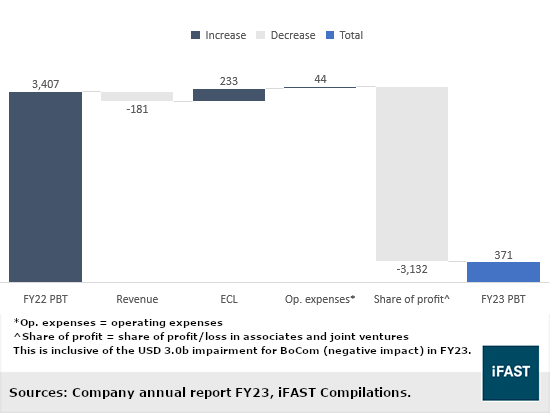
Chart 4
(Left)
Wholesale Lending in mainland China for HSBC across past quarters (in USD b)
(Right) HSBC’s Commercial Real
Estate exposure in Asia (in USD b)
HSBC’s outlook in the near term
We remain optimistic about HSBC’s profit outlook and we believe these factors – 1) HSBC’s proposition as a global bank, 2) continued cost discipline and 3) resilient banking NII – will allow HSBC to sustain its growing profitability.
Firstly, HSBC’s strength as a global bank and its focus on further building its international business will likely be its key growth driver. HSBC expects the world to increasingly re-globalise than de-globalise, highlighting mid-market corporates that seek to develop and expand internationally. It sees a competitive advantage within this particular segment, alongside further opportunities to extend its market leadership. In FY23, HSBC saw a 43% increase in new-to-bank international customers YoY, owing to its proposition as a global bank.
We see HSBC as being well-positioned to execute this strategy given its strong presence in various markets – particularly in mainland China, Singapore and India. These markets are where HSBC reported significant profits of more than USD 1b in FY23 (for mainland China, this profit excludes associates).
Secondly, supporting the bank’s earnings growth is the continued focus on maintaining cost discipline. HSBC has made efforts to control costs over recent years, especially against the backdrop of elevated inflation. To drive longer-term efficiency, HSBC has reinvested the cost savings into digitalisation – a trend that many banks are embarking on. For HSBC, it started tapping into AI to assist its Foreign Exchange business, reducing execution times down from hours to minutes.
And lastly, HSBC still expects a banking NII of at least USD 41b in FY24 (in contrast to FY23 banking NII of USD 44.1b). Across the year, HSBC experienced a drop in net interest margin (“NIM”), mainly in 4Q23 with NIM falling from 1.70% (3Q23) to 1.52% (4Q23). The NIMs across most banks have fallen throughout FY23, given slower loan growth amidst mixed economic results and higher deposit passthroughs to sustain funding.
Recognising the need to contain such an impact, HSBC increased the size and duration of its structural hedge which greatly reduced the sensitivity of banking NII to interest rate movements. HSBC estimated that a reduction of 100 basis points (“bps”) in interest rates in a year will only reduce the banking NII by USD 1.6b, as of 31 December 2023, as compared to a USD 6.0b drop, as of 30 June 2022.
While potential rate cuts across the globe might be a headwind for HSBC, we continue to see clear growth drivers for the bank. In our view, its strategic advantage as a global bank offset the lower banking NII in FY24. As such, we believe that HSBC will be able to sustain the current growth trajectory in the coming years.
Credit and Solvency Profile
HSBC’s credit profile remained largely stable in FY23, owing to the strong capital generation in FY23 offsetting the pay-outs to shareholders. The CET1 ratio increased from 14.2% as of December 2022 to 14.8% as of December 2023, with capital generation contributing a 100 bps increase over the period (after accounting for dividends and share buybacks). Moving ahead, HSBC expects a contribution of 70 bps from the sale of its Canada business after accounting for special dividends from the sale, and also a reduction of 25 bps for the USD 2b share buyback announced in 1Q24.
Currently, the CET1 ratio of 14.8% holds a considerable buffer over the maximum distributable amount hurdle of 11.2% for HSBC. It targets a range of 14.0% to 14.5% in the medium term, a manageable level given the substantial buffer. While HSBC’s CET1 ratio might face possible negative impacts from the introduction of Basel 3.1 which affects the calculation of risk-weighted assets, we expect continued capital generation to offset such impacts.
Asset quality was roughly unchanged, with overall ECL at 33 bps in FY23 as compared to 35 bps in FY22. Looking forward, HSBC expects an ECL charge of 40 bps in FY24 inclusive of the impact relating to mainland China CRE. Meanwhile, liquidity continues to remain adequate with a liquidity coverage ratio of 136%, net stable funding ratio of 133% and high-quality liquid assets of USD 795b (against total deposits of USD 1,612b for the Group).
Recommendations
Table 1
SGD Tier 2 Issuances
|
Issues |
Ask Price |
Yield to Call/Maturity |
Years to Call/Maturity |
Bond Credit Rating (S&P/Fitch) |
|
100.875 |
4.56% / 4.75% |
5.43 / 10.43 |
BBB/ A- |
|
|
102.383
|
4.64% / 4.88% |
4.37 / 9.38 |
BBB- / BBB+ |
|
|
99.141 |
4.60% / 4.93% |
1.12 / 6.13 |
BBB- / BBB+ |
|
|
100.250 |
4.94% / 5.05% |
4.92 / 9.92 |
BBB / BBB+ |
|
|
100.900 |
4.54% / 4.80% |
4.86 / 9.86 |
BBB+ / A- |
|
|
Sources: Bloomberg Finance L.P., Bondsupermart, iFAST Compilations. Data as of 8 April 2024. |
||||
HSBC’s latest Tier 2 SGD subordinated issuance HSBC 4.750% 12Sep2034 Corp (SGD) offers a competitive 4.56% yield to call at the ask price of 100.875. We like HSBC for the quality and the substantial market share that it offers, backed by a generally optimistic outlook. HSBC’s SGD issuances would be a good choice for investors looking at bank bonds, particularly those from UK banks. Alternatively, for investors looking for a higher yield, BPCEGP 5.000% 08Mar2034 Corp (SGD) will also be a good option that has a slightly lower credit rating (within investment grade).
Table 2
HSBC
Senior Unsecured USD Issuances
|
Issues |
Ask Price |
Yield to Call/Maturity |
Years to Call/Maturity |
|
98.934 |
5.83% / 6.45% |
0.67 / 1.67 |
|
|
98.292 |
5.55% / 6.11% |
1.43 / 2.43 |
|
|
100.720 |
5.55% / 5.94% |
2.35 / 3.35 |
|
|
100.335 |
5.47% / 5.66% |
4.91 / 5.91 |
|
|
Sources: Bloomberg Finance L.P., Bondsupermart, iFAST Compilations. Data as of 8 April 2024. |
|||
Meanwhile, we find value in HSBC’s senior unsecured USD papers, offering relatively attractive yields against other major banks at similar credit ratings. We believe this is due to the risk that HSBC holds given a portion of its portfolio being in China. In Table 2, we have highlighted several preferred HSBC bonds amongst its USD offerings, mostly of a shorter duration. For investors looking at a slightly longer tenor, HSBC 5.546% 04Mar2030 Corp (USD) can be a great consideration – a newly issued paper that we have just onboarded onto Bond Express for its attractive yield as well.
Declaration: For specific disclosure, at the time of publication of this report, IFPL (via its connected and associated entities) holds a position in HSBC 5.300% 14Mar2033 Corp (SGD), HSBC 5.546% 04Mar2030 Corp (USD), HSBC 4.375% 23Nov2026 Corp (USD), BNP 4.750% 15Feb2034 Corp (SGD), HSBC 6.500% 20May2024 Corp (GBP), HSBC 6.211% 21Mar2034 Corp (AUD), and the analyst who produced this report holds a NIL position in the abovementioned securities.
Our podcast series, Yield Hunters, is available on Spotify, iTunes Podcasts and Google Podcasts. We share our thoughts on new bond issues and hold discussions on the fixed income space. Listen to our latest episode below and follow us!